- Unemployment rate stuck at 4.9%, with drops in both the labor force and employment.
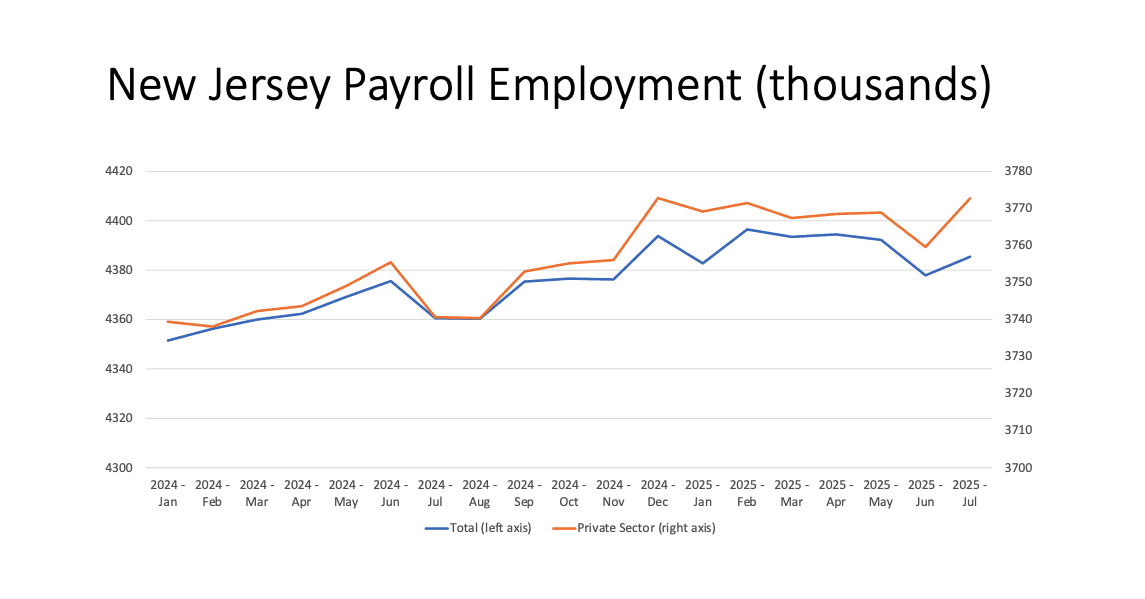
- Sharp 13,100 gain in private employment partly offset by a downward revision to June and a large cut in public jobs.
New Jersey’s July labor market figures can be cut a number of ways. The state’s unemployment rate remained high at 4.9%. For a second straight month, both the labor force and employment declined—certainly not encouraging.
The job count numbers look much better. There was an overall increase of 7,500, which is the best since February. While a downward revision to June offset most of the July increase, and left the total count under the February-May average, the industry composition was encouraging, with private-sector jobs up 13,100. A very sharp 5,600 in government employment took much of the glow away from the overall performance. It may be arguable that concerns over federal funding have led to unusually large staff cuts at public institutions such as schools (for instance, limited or delayed hiring of replacement for teachers who left positions at the end of the school year). Within the private sector, there were large gains in professional and business services (7,700), and leisure and hospitality (3,000); construction was down 1,600.
The overall view would appear to be mixed. The unemployment news is certainly glum, and the drop in the public sector may suggest some tough times are looming there, but the private sector job results were good to see; bringing the job count there back to about where it started the year after some fairly bleak results.
The July results in New York state were strikingly different. On the household side, there was little difference, with declines in the labor force and employment (New York’s unemployment rate was unchanged at 4.0%). On the payroll side, the private sector gain in New York was smaller than in New Jersey, but there was a very large increase in the public sector (over 40,000). No explanation for that has appeared.
There has been recent discussion about revisions to job count estimates. It’s useful to keep in mind that these figures are estimates, based on samples. Initial estimates are revised as more of the sample is collected, as well as the receipt of other information (such as unemployment insurance records and more data to estimate normal seasonal patterns). There is always great interest in getting an estimate as soon as possible, but that widens the chance that subsequent revisions will be large.