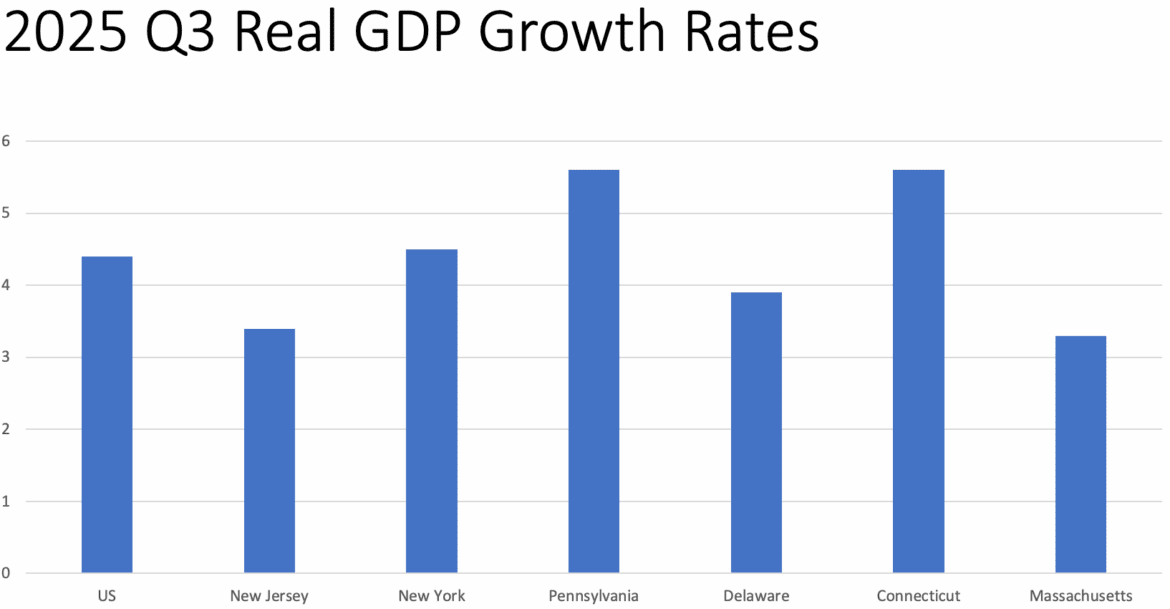

- Real GDP growth rate of 3.4% well under national pace of 4.4% and most neighbors.
- Personal income growth rate 3.0% also under the nation’s 3.3%.
The delayed information on 20225 third-quarter state GDP and personal income showed that New Jersey’s economy was relatively sluggish. Real GDP grew at a 3.0% annual rate. That, by itself, is not a bad result, but it was substantially less than the nation’s 4.4% growth rate. That followed a comparably weak showing in the second quarter (New Jersey’s growth rate of 2.8% was a point less than the nation). Moreover, New Jersey ranked in the bottom 10, and growth rates in the region were higher: New York’s growth rate was 4.5%, Pennsylvania and Connecticut at 5.6%, and Delaware’s 3.9%. Indeed, New Jersey had the second lowest growth rate of any state east of the Mississippi (Massachusetts had a 3.3% growth rate; DC, not a state, was much lower, obviously reflecting developments in the federal government).
State GDP is computed from estimates of output by industry. Most New Jersey industries grew more slowly in the third quarter than their national counterparts; the largest gaps were in durable goods manufacturing and the state and local government sector.
New Jersey’s personal income showed up better, with our 3.0% growth only modestly under the nation’s 3.3%, and comparable or better to numbers of other states in the region (and substantially higher than Massachusetts’ meager 1.2%). Still, incomes of Pennsylvanians rose at a robust 4.7% rate and New York clocked 4.2%.. Net earnings (employee compensation plus the profits on noncorporate business) of New Jersey residents contributed 1.8 percentage points to the state’s overall income gain, which was under the national figure of 2.2 percentage points. That gap accounted for the difference between income growth in New Jersey and the nation. Most of the gap between New Jersey’s income growth and New York’s was attributable to transfer payments, though net earnings growth was a touch stronger in New York (Pennsylvania saw substantially higher growth in both earnings and transfers).