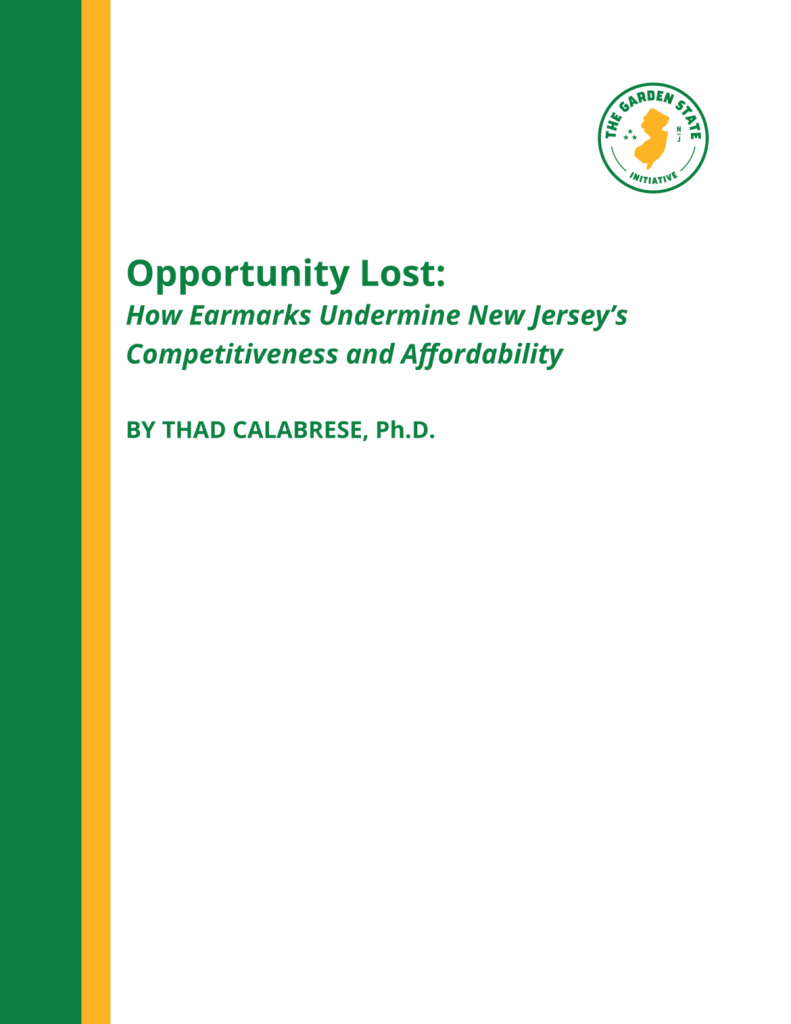
The Garden State Initiative released a new report today highlighting how Trenton’s legislative earmarks are driving up costs for New Jersey families and businesses, while eroding transparency in state government.
The report, released in advance of Governor Mikie Sherrill’s initial budget address tomorrow and authored by New York University finance professor Thad Calabrese, reveals that secretive discretionary spending inserted into the state budget has grown dramatically in recent years to $2.1 billion (FY24-26). In Fiscal Year 2026 alone, the legislature added $860 million in earmarks, funding not requested by the Governor and often approved behind closed doors.
Key Findings of the Report Include:
- 450% increase in the number of private and nonprofit organizations receiving state funds over just two years, from 101 in FY 2024 to 462 in FY 2026.
- $240 per household per year is effectively being spent on these “extra” budget items
- These discretionary expenditures over the last few years could otherwise fund a 4% across-the-board income tax cut, pay down 5% of the state’s massive bonded debt, or even eliminate income taxes on those making $50,000 or less, for example
- There is little to no transparency of how funding is generated, reviewed, or approved without standardized data-driven criteria to determine the public need addresses. This increases incentives to maximize political connections to obtain taxpayer resources
“There is a lot of talk about affordability these days, which is more pronounced with a $3 billion budget deficit this year,” said Audrey Lane, President of the Garden State Initiative. “One place for the Governor to look is to hold the line on last-minute discretionary spending. Since 2024, the legislature has add $2.1 billion in politically connected spending without any standard review process, that could otherwise pay down our debt, provide significant tax relief for struggling families and businesses. What this report suggests is that the Governor and the legislature can reform this earmark process to increase transparency of this spending well in advance of the budget deadlines to ensure it meets a public need in an objective way. I look forward to hearing Governor Sherrill’s budget address tomorrow—her acknowledgment of the structural deficit is welcomed and is the first step toward meaningful budget reform.”
The Garden State Initiative also updated NJBUDGET.COM today to reflect new Fiscal 2026 data: over $118 million in supplemental appropriations approved by the State Legislature through the passage of Assembly Bill #6319, signed into law by Governor Murphy on January 20th, just prior to leaving office. These funds support nearly 20 projects, most of which were not previously funded in the Fiscal 2026 Appropriations Act, and nearly all will be passed through to third parties in the form of State Aid and Grants-In-Aid.
The report underscores that these spending practices reduce fiscal predictability, limit transparency, and hinder New Jersey’s business competitiveness.
The report calls for three key reforms:
- Eliminate non-competitive legislative add-ons.
- Redirect earmark funds toward broad-based tax relief or debt reduction.
- Require full transparency and public bidding for any grants to third-party organizations.
A copy of the report can be downloaded here.
About the Garden State Initiative
The Garden State Initiative is a 501(c)(3) nonprofit dedicated to strengthening New Jersey by advancing an alternative voice and common-sense policy solutions that promote investment, job growth, economic opportunity, and innovation for all New Jerseyans.
###