

A new study examining nearly four decades of New Jersey’s affordable housing policies finds that the state’s Mount Laurel obligations, established by landmark court decisions and later codified in legislative frameworks, have largely failed to increase housing production or reduce housing costs.
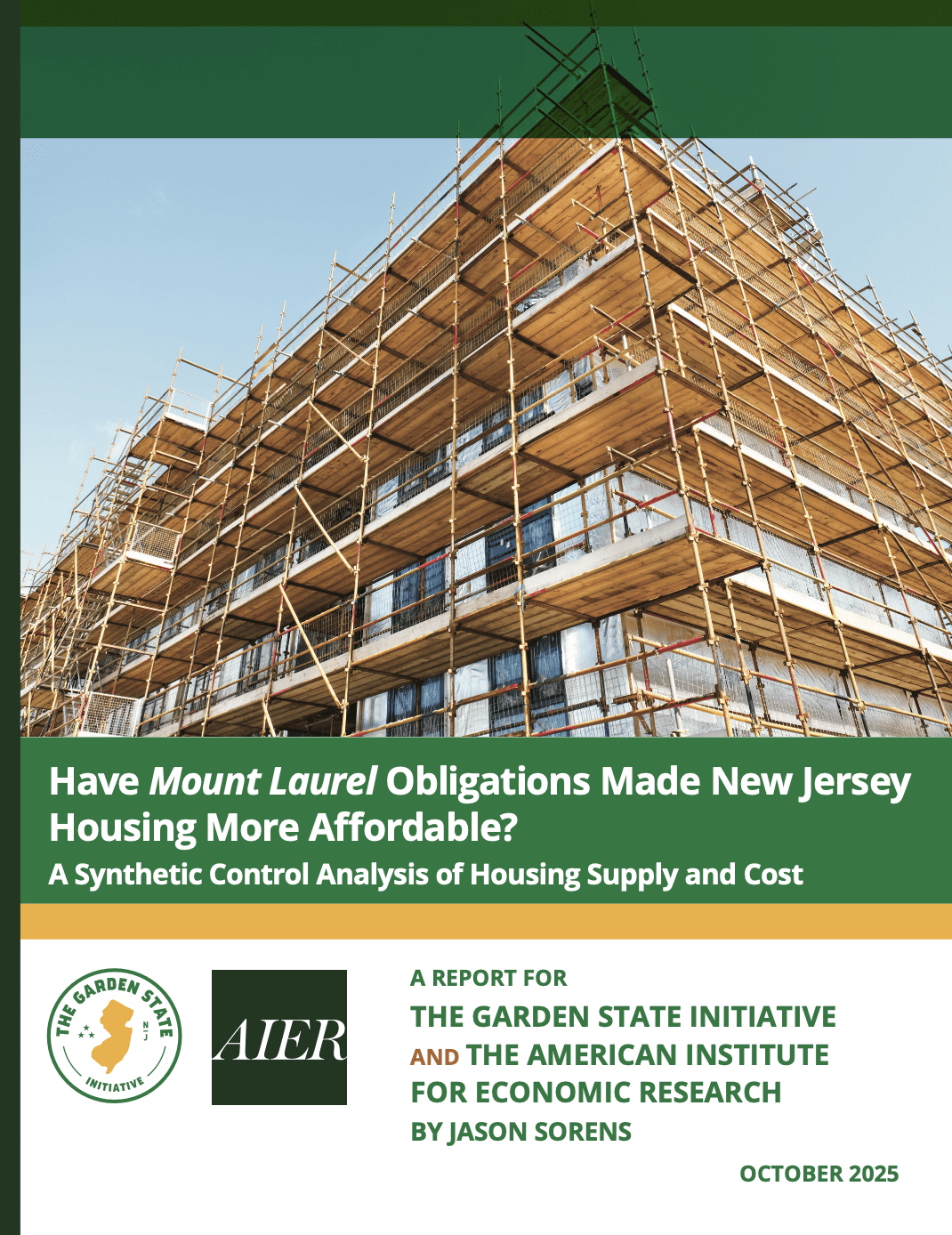
The report, Have Mount Laurel Obligations Made New Jersey Housing More Affordable?, analyzes the effects of mandatory and voluntary inclusionary zoning programs under the Fair Housing Act of 1985 and subsequent legislative interpretations. Using synthetic control analysis, the study compared New Jersey to other states—including Pennsylvania, New York, Massachusetts, Connecticut, Florida, Nevada, Arizona, and California—to estimate what housing production and costs would have looked like in the absence of Mount Laurel obligations.
Key Findings:
- Minimal impact on housing production: Despite New Jersey’s denser population and nearly four decades of Mount Laurel obligations, the state’s per capita housing production has largely mirrored Pennsylvania’s—a state without comparable legal mandates—showing little evidence that the policies increased supply. Similar patterns were observed when compared to the broader set of states analyzed.
- Limited effect on housing costs: There is minimal evidence that Mount Laurel obligations lowered the cost of housing or overall cost of living. Periods of judicial enforcement without legislative frameworks showed modest improvements, but overall effects remain negligible.
- Urban exemptions limit impact: Current legislation, Act 2 of 2024, exempts urban municipalities from affordable housing obligations, even though these areas often have the greatest demand for reasonably priced housing. This exemption restricts the policy’s potential to improve affordability where it is most needed.
Jason Sorens, author of the study and Senior Fellow at the American Institute for Economic Research (AIER), said:
“New Jersey’s Fair Housing Act, born from the Mount Laurel cases, was meant to make housing more affordable, but failed. But our research shows, housing production in New Jersey has largely mirrored Pennsylvania, a state without comparable legal mandates, showing that decades of mandates made little difference. The state would be better off cutting red tape and letting property owners build housing that fits local infrastructure.”
Audrey Lane, President of the Garden State Initiative, added:
“Despite decades of legal rulings and legislative policies, New Jersey has not expanded its supply of affordable housing. Legislators should reconsider housing solutions that leverage the benefits of our urban areas—transportation, infrastructure, and jobs—without fueling suburban sprawl—and pursue policies that expand access for those who want to call New Jersey home but cannot currently afford it.”
Policy Recommendations:
- Extend affordable housing obligations to all municipalities, including urban areas currently exempt, to ensure housing availability where demand is greatest.
- Shift from municipal to regional affordable housing targets to better align with market demand.
- Leverage private property rights and market incentives to grow housing supply.
- Streamline permitting processes to encourage timely development and reduce regulatory bottlenecks.
The study underscores the need to rethink New Jersey’s housing policy, focusing on general housing abundance and market-oriented solutions rather than prescriptive mandates.
About the Study:
Have Mount Laurel Obligations Made New Jersey Housing More Affordable? provides a comprehensive empirical analysis of housing production, costs, and affordability in New Jersey since the 1975 Mount Laurel decision, evaluating the effectiveness of both legislative and judicial interventions in meeting affordable housing goals.